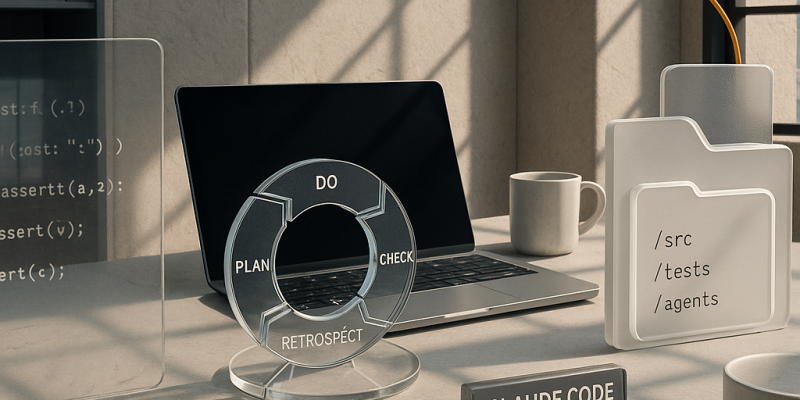
PDCVR and Agentic Workflows Industrialize AI‐Assisted Software Engineering
Published Jan 3, 2026
If your team is losing a day to routine code changes, listen: Reddit posts from 2026‐01‐02/03 show practitioners cutting typical 1–2‐day tasks from ~8 hours to about 2–3 hours by combining a Plan–Do–Check–Verify–Retrospect (PDCVR) loop with multi‐level agents, and this summary tells you what they did and why it matters. PDCVR (reported 2026‐01‐03) runs in Claude Code with GLM‐4.7, forces RED→GREEN TDD in planning, keeps small diffs, uses build‐verification and role subagents (.claude/agents) and records lessons learned. Separate posts (2026‐01‐02) show folder‐level instructions and a prompt‐rewriting meta‐agent turning vague requests into high‐fidelity prompts, giving ~20 minutes to start, 10–15 minutes per PR loop, plus ~1 hour for testing. Tools like DevScribe make docs executable (DB queries, ERDs, API tests). Bottom line: teams are industrializing AI‐assisted engineering; your immediate next step is to instrument reproducible evals—PR time, defect rates, rollbacks—and correlate them with AI use.

RLI Reveals Agents Can't Automate Remote Work; Liability Looms
Published Nov 10, 2025
The Remote Labor Index benchmark (240 freelance projects, 6,000+ human hours, $140k payouts) finds frontier AI agents automate at most 2.5% of real remote work, with frequent failures—technical errors (18%), incomplete submissions (36%), sub‐professional quality (46%) and inconsistent deliverables (15%). These empirical limits, coupled with rising legal scrutiny (e.g., the AI LEAD Act applying product‐liability principles and mounting IP/liability risk for code‐generating tools), compel an expectation reset. Organizations should treat agents as assistive tools, enforce human oversight and robust fallback processes, and maintain documentation of design, data, and error responses to mitigate legal exposure. Benchmarks like RLI provide measurable baselines; until performance improves materially, prioritize augmentation over replacement.