PDCVR and Agentic Workflows Industrialize AI‐Assisted Software Engineering

PDCVR and Agentic Workflows Industrialize AI‐Assisted Software Engineering

Published Jan 3, 2026

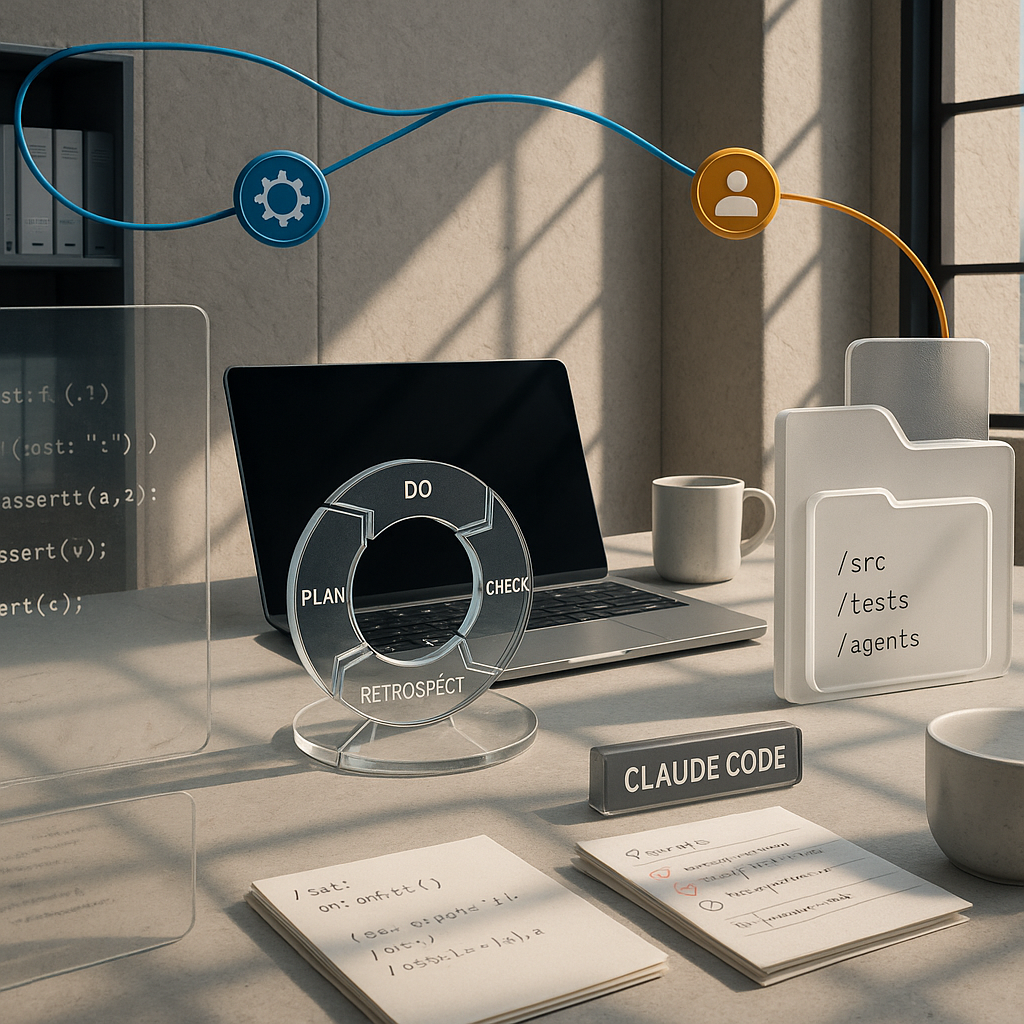
If your team is losing a day to routine code changes, listen: Reddit posts from 2026‐01‐02/03 show practitioners cutting typical 1–2‐day tasks from ~8 hours to about 2–3 hours by combining a Plan–Do–Check–Verify–Retrospect (PDCVR) loop with multi‐level agents, and this summary tells you what they did and why it matters. PDCVR (reported 2026‐01‐03) runs in Claude Code with GLM‐4.7, forces RED→GREEN TDD in planning, keeps small diffs, uses build‐verification and role subagents (.claude/agents) and records lessons learned. Separate posts (2026‐01‐02) show folder‐level instructions and a prompt‐rewriting meta‐agent turning vague requests into high‐fidelity prompts, giving ~20 minutes to start, 10–15 minutes per PR loop, plus ~1 hour for testing. Tools like DevScribe make docs executable (DB queries, ERDs, API tests). Bottom line: teams are industrializing AI‐assisted engineering; your immediate next step is to instrument reproducible evals—PR time, defect rates, rollbacks—and correlate them with AI use.

Industrializing AI Software Engineering with PDCVR Loops and Agent Stacks

What happened

Practitioners on r/ExperiencedDevs and accompanying GitHub repos (posts dated 2026‐01‐02 and 2026‐01‐03) described converging, production‐tested patterns for AI‐assisted software engineering. Chief examples: a Plan–Do–Check–Verify–Retrospect (PDCVR) loop for every substantive change (inspect repo → stepwise plan with TDD → small diffs → automated build/test verification → retrospection) and multi‐level agent stacks (folder‐level instructions + prompt‐rewriting meta‐agents). Reports include claimed throughput improvements (typical 1–2 day tasks reduced to ~2–3 hours) and public prompt/agent templates on GitHub; a separate post contrasts Obsidian with DevScribe to show docs evolving into executable engineering workspaces.

Why this matters

Process and tooling shift — industrializing AI‐assisted engineering. These posts signal a move from ad‐hoc prompts to disciplined, auditable workflows that:

  • embed agents into conventional SDLC gates (planning, verification, retrospection),
  • give agents spatial constraints (folder‐level rules) and temporal discipline (PDCVR),
  • enable reproducible prompts, sub‐agents, and build/test automation (helpful for regulated sectors like fintech, healthcare, infra).

Practical impacts and caveats:

  • Reported productivity gains are large (authors cite ~3–4× throughput on routine work and examples like “2–3 hours instead of a full day”), but quality is not guaranteed — one author notes quicker low‐quality drafts that still require human remediation.
  • The approach aligns with prior research advocating test‐driven workflows for LLM codegen and with PDCA‐style process thinking, suggesting real potential for safer, auditable automation.
  • Authors call for reproducible evals and metrics (PR time, defect rates, rollback frequency) rather than anecdotes — implying teams should instrument outcomes before broad adoption.

Sources

Revolutionizing Task Efficiency with Multi-Level Agents and Contextual Scaffolding

  • Total time per routine task — 2–3 hours (vs ~8 hours previously), 3–4× throughput, compresses typical 1–2 day feature/change work in a large production system via multi-level agents and contextual scaffolding.
  • Initial prompt creation time — ~20 minutes per task, enables rapid kickoff by using a prompt‐rewriting meta‐agent to generate high‐fidelity instructions.
  • PR feedback loop duration — 10–15 minutes per loop (2–3 loops), shortens iteration latency for reviews compared to manual prompting/edits.
  • Testing and verification time — ~1 hour per task, consolidates quality checks into a faster agent‐assisted workflow.

Balancing Speed with Quality, Security, and Compliance in Multi-Agent Workflows

  • Bold risk label: Quality debt amplified by speed; why it matters: Multi‐agent workflows cut typical 1–2 day tasks from ~8 hours to ~2–3 hours, meaning “bad code” can reach production faster without strong CHECK/VERIFY gates, increasing defect and rollback risk in production services and especially in fintech/health/critical infra. Turn it into an opportunity by institutionalizing PDCVR with RED→GREEN TDD and build‐verification sub‐agents, letting platform teams gain throughput while maintaining auditable quality.
  • Bold risk label: Security and data‐governance exposure from executable docs and repo‐wide agents (est.); why it matters: DevScribe can execute DB queries and API tests inside docs, and open‐source agent definitions (orchestrator/debugger/build‐verifier) can modify code—without strict sandboxing, this raises risks of secret leakage, prod‐data access, or supply‐chain misuse. Opportunity: adopt offline/air‐gapped workspaces, folder‐level policies, and RBAC for agents to safely enable “docs as programmable surfaces,” benefiting finance, defense, and on‐prem healthcare.
  • Bold risk label: Known unknown — Reproducible, workflow‐level efficacy and compliance evidence; why it matters: Practitioners explicitly want metrics beyond anecdotes, yet many teams lack instrumentation for PR review time, defect rates, rollback frequency, and agent proposal acceptance—undermining ROI cases and audit defensibility. Opportunity: build evaluation pipelines and benchmarks for agentic workflows, giving infra/platform teams and regulated orgs a data‐backed adoption path and competitive advantage.

Near-Term AI Milestones Driving Agile Workflows and Verified Coding Efficiency

PeriodMilestoneImpact
Jan 2026 (TBD)Community posts reproducible AI coding evals answering OP’s metrics request on Reddit.Enables workflow benchmarks: PR review time, defect rates, rollback frequency correlations.
Jan 2026 (TBD)Projects adopt PDCVR templates; publish results from build‐verification sub‐agents in CI.Validates plan–execute–verify loops; improves auditable change control in production repos.
Jan 2026 (TBD)Teams report replicated 2–3 hour cycles for typical 1–2 day tasks.Confirms 3–4× throughput via multi‐level agents and folder‐level instructions.
Jan 2026 (TBD)Reviews compare DevScribe vs Obsidian for executable offline engineering workflows.Guides selection of docs‐as‐execution tools in finance, defense, on‐prem healthcare.

From Autonomous Myths to Accountable Automation: AI Coding Needs Control, Not Freedom

Depending on where you stand, these posts read as a discipline-first blueprint or a bureaucratic exoskeleton. Supporters point to PDCVR’s plan–execute–verify cadence and multi‐agent scaffolds turning 1–2 day tasks into 2–3 hour runs, with folder‐level rules and a prompt‐rewriting meta‐agent reducing guesswork and architecture drift. Skeptics counter that the quality floor hasn’t moved—“The agent produce the bad code in 5 minutes... instead of me or another human producing the same dogshit code in 10 hours” (Reddit, 2026‐01‐02)—and that a stack of sub‐agents plus tests is still just guardrails for average output. The marketing myth of “fully autonomous dev agents” gets punctured by reality: small, constrained roles wired into SDLC gates. And the community itself is calling time on hand‐wavy claims, demanding prompts, contexts, and outcomes they can reproduce. Provocation: If your AI workflow can’t survive a PR diff and a test suite, it isn’t engineering—it’s theater.

Here’s the twist the evidence suggests: control, not creativity, is the accelerant. Add plan–do–check–verify loops, folder‐level invariants, and meta‐agents, and throughput jumps precisely because the system narrows options and makes verification cheap—especially when “docs” become executable workspaces that bind APIs, schemas, and tests. The next shifts will be cultural and operational: teams treating agents as services, codifying .claude/agents‐style roles, and instrumenting PR review time, defect rates, rollbacks, and acceptance rates to benchmark workflows—not models—across green/yellow/red tasks. Watch regulated and offline domains lean in, where auditability is table stakes and the appetite for speed is high. The future of AI coding isn’t autonomy; it’s accountable automation.