Programmable Sound: AI Foundation Models Are Rewriting Music and Game Audio
Published Dec 6, 2025
Tired of wrestling with flat, uneditable audio tracks? Over the last 14 days major labs and open‐source communities converged on foundation audio models that treat music, sound and full mixes as editable, programmable objects—backed by code, prompts and real‐time control—here’s what that means for you. These scene‐level, stem‐aware models can separate/generate stems, respect structure (intro/verse/chorus), follow MIDI/chord constraints, and edit parts non‐destructively. That shift lets artists iterate sketches and swap drum textures without breaking harmonies, enables adaptive game and UX soundtracks, and opens audio agents for live scoring or auto‐mixing. Risks: style homogenization, data provenance and legal ambiguity, and latency/compute tradeoffs. Near term (12–24 months) action: treat models as idea multipliers, invest in unique sound data, prioritize controllability/low‐latency integrations, and add watermarking/provenance for safety.

Meet the AI Agents That Build, Test, and Ship Your Code
Published Dec 6, 2025
Tired of bloated “vibe-coded” PRs? Here’s what you’ll get: the change, why it matters, and immediate actions. Over the past two weeks multiple launches and previews showed AI-native coding agents moving out of the IDE into the full software delivery lifecycle—planning, implementing, testing and iterating across entire repositories (often indexed at millions of tokens). These agentic dev environments integrate with test runners, linters and CI, run multi-agent workflows (planner, coder, tester, reviewer), and close the loop from intent to a pull request. That matters because teams can accelerate prototype-to-production cycles but must manage costs, latency and trust: expect hybrid or self-hosted models, strict zoning (green/yellow/red), test-first workflows, telemetry and governance (permissions, logs, policy). Immediate steps: make codebases agent-friendly, require staged approvals for critical systems, build prompt/pattern libraries, and treat agents as production services to monitor and re-evaluate.
Vibe Coding with AI Is Breaking Code Reviews — Fix Your Operating Model
Published Dec 6, 2025
Is your team drowning in huge, AI‐generated PRs? In the past 14 days engineers have reported a surge of “vibe coding” — heavy LLM‐authored code dumped into massive pull requests (Reddit, r/ExperiencedDevs, 2025‐12‐05; 2025‐11‐21) that add unnecessary abstractions and misaligned APIs, forcing seniors to spend 12–15 hours/week on reviews (Reddit, 2025‐11‐20). That mismatch — fast generation, legacy review norms — raises operational and market risk for fintech, quant, and production systems. Teams are responding with clear fixes: green/yellow/red zoning for AI use, hard limits on PR diff size, mandatory design docs and tests, and treating AI like a junior that must be specified and validated. For leaders: codify machine‐readable architecture guides, add AI‐aware CI checks, and log AI involvement — those steps turn a short‐term bottleneck into durable advantage.

Edge AI Meets Quantum: MMEdge and IBM Reshape the Future
Published Nov 19, 2025
Latency killing your edge apps? Read this: two near-term advances could change where AI runs. MMEdge (arXiv:2510.25327) is a recent on‐device multimodal framework that pipelines sensing and encoding, uses temporal aggregation and speculative skipping to start inference before full inputs arrive, and—tested in a UAV and on standard datasets—cuts end‐to‐end latency while keeping accuracy. IBM unveiled Nighthawk (120 qubits, 218 tunable couplers; up to 5,000 two‐qubit gates; testing late 2025) and Loon (112 qubits, six‐way couplers) as stepstones toward fault‐tolerant QEC and a Starling system by 2029. Why it matters to you: faster, deterministic edge decisions for AR/VR, drones, medical wearables; new product and investment opportunities; and a need to track edge latency benchmarks, early quantum demos, and hardware–software co‐design.

Google Unveils Gemini 3.0 Pro: 1T-Parameter, Multimodal, 1M-Token Context
Published Nov 18, 2025
Worried your AI can’t handle whole codebases, videos, or complex multi-step reasoning? Here’s what to expect: Google announced Gemini 3.0 Pro / Deep Think, a >1 trillion-parameter Mixture-of-Experts model (about 15–20B experts active per query) with native text/image/audio/video inputs, two context tiers (200,000 and 1,000,000 tokens), and stronger agentic tool use. Benchmarks in the article show GPQA Diamond 91.9%, Humanity’s Last Exam 37.5% without tools and 45.8% with tools, and ScreenSpot-Pro 72.7%. Preview access opened to select enterprise users via API in Nov‐2025, with broader release expected Dec‐2025 and general availability early 2026. Why it matters: you can build longer, multimodal, reasoning-heavy apps, but plan for higher compute/latency, privacy risks from audio/video, and robustness testing. Immediate watch items: independent benchmark validation, tooling integration, pricing for 200k vs 1M tokens, and modality-specific safety controls.
Edge AI Revolution: 10-bit Chips, TFLite FIQ, Wasm Runtimes
Published Nov 16, 2025
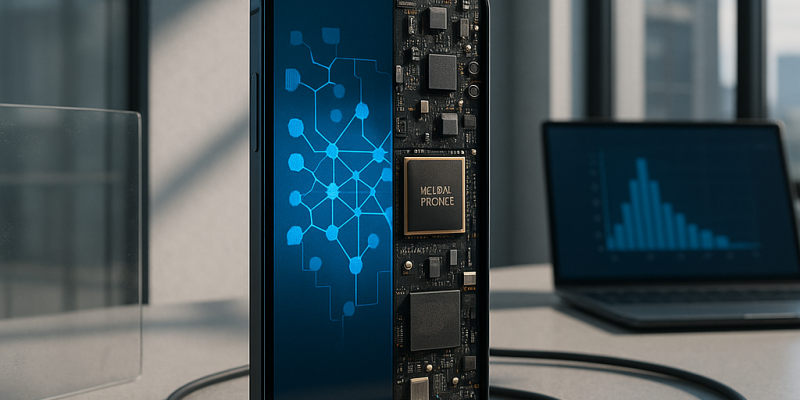
Worried your mobile AI is slow, costly, or leaking data? Recent product and hardware moves show a fast shift to on-device models—and here’s what you need. On 2025-11-10 TensorFlow Lite added Full Integer Quantization for masked language models, trimming model size ~75% and cutting latency 2–4× on mobile CPUs. Apple chips (reported 2025-11-08) now support 10‐bit weights for better mixed-precision accuracy. Wasm advances (wasmCloud’s 2025-11-05 wash-runtime and AoT Wasm results) deliver binaries up to 30× smaller and cold-starts ~16% faster. That means lower cloud costs, better privacy, and faster UX for AR, voice, and vision apps, but you must manage accuracy, hardware variability, and tooling gaps. Immediate moves: invest in quantization-aware pipelines, maintain compressed/full fallbacks, test on target hardware, and watch public quant benchmarks and new accelerator announcements; adoption looks likely (estimated 75–85% confidence).

Agentic AI Workflows: Enterprise-Grade Autonomy, Observability, and Security
Published Nov 16, 2025
Google Cloud updated Vertex AI Agent Builder in early November 2025 with features—self‐heal plugin, Go support, single‐command deployment CLI, dashboards for token/latency/error monitoring, a testing playground and traces tab, plus security features like Model Armor and a Security Command Center—and Vertex AI Agent Engine runtime pricing begins in multiple regions on November 6, 2025 (Singapore, Melbourne, London, Frankfurt, Netherlands). These moves accelerate enterprise adoption of agentic AI workflows by improving autonomy, interoperability, observability and security while forcing regional cost planning. Academic results reinforce gains: Sherlock (2025‐11‐01) improved accuracy ~18.3%, cut cost ~26% and execution time up to 48.7%; Murakkab reported up to 4.3× lower cost, 3.7× less energy and 2.8× less GPU use. Immediate priorities: monitor self‐heal adoption and regional pricing, invest in observability, verification and embedded security; outlook confidence ~80–90%.

UK Moves to Authorize Pre-Deployment AI Testing for Illegal Sexual Content
Published Nov 16, 2025
On 12 November 2025 the UK government filed amendments to the Crime and Policing Bill to designate AI developers and child‐protection organisations (e.g., the Internet Watch Foundation) as “authorised testers” legally permitted to test models for generating CSAM, NCII and extreme pornography and to use a new “testing defence” shielding such tests from prosecution. The change responds to IWF data showing AI‐generated CSAM reports more than doubled (199 in 2024 to 426 in 2025), images of children aged 0–2 rose from 5 to 92, and Category A material increased from 2,621 to 3,086 items (now 56% vs 41% prior year). If enacted, regulators must set authorised‐tester criteria and safeguards; immediate implications include mandated pre‐deployment safety testing by developers, expanded technical roles for NGOs, and new obligations tied to model release.

OpenAI Turbo & Embeddings: Lower Cost, Better Multilingual Performance
Published Nov 16, 2025
Over the past 14 days OpenAI rolled out new API updates: text-embedding-3-small and text-embedding-3-large (small is 5× cheaper than prior generation and improved MIRACL from 31.4% to 44.0%; large scores 54.9%), a GPT-4 Turbo preview (gpt-4-0125-preview) fixing non‐English UTF‐8 bugs and improving code completion, an upgraded GPT-3.5 Turbo (gpt-3.5-turbo-0125) with better format adherence and encoding fixes plus input pricing down 50% and output pricing down 25%, and a consolidated moderation model (text-moderation-007). These changes lower retrieval and inference costs, improve multilingual and long-context handling for RAG and global products, and tighten moderation pipelines; OpenAI reports 70% of GPT-4 API requests have moved to GPT-4 Turbo. Near term: expect GA rollout of GPT-4 Turbo with vision in coming months and close monitoring of benchmarks, adoption, and embedding dimension trade‐offs.

China's Ban on Foreign AI Chips Threatens Global Hardware Ecosystem
Published Nov 16, 2025
On 2025-11-05 Reuters reported that China issued guidance requiring state‐funded data centres under construction to use only domestically produced AI chips, forcing projects under 30% completion to remove foreign chips and subjecting more mature builds to case‐by‐case review; foreign suppliers named include Nvidia, AMD and Intel and even advanced Nvidia parts (H20, B200, H200) are barred. The directive aims to cut reliance on foreign hardware amid U.S. export controls and fast‐tracks market share to domestic vendors such as Huawei, Cambricon, MetaX and Moore Threads; Reuters cites Nvidia’s share in China falling from ~95% in 2022 to zero under the move and reports suspended projects. Expect technical risks (immature software stacks, supply disruptions), geopolitical tension and supply‐chain realignment; monitor formal rules late 2025–early 2026, capacity ramps 2025–2027, project delays in the next six months and foreign or allied responses through 2026.