AI‐Native Operating Models: How Agents Are Rewriting Engineering Workflows

AI‐Native Operating Models: How Agents Are Rewriting Engineering Workflows

Published Jan 3, 2026

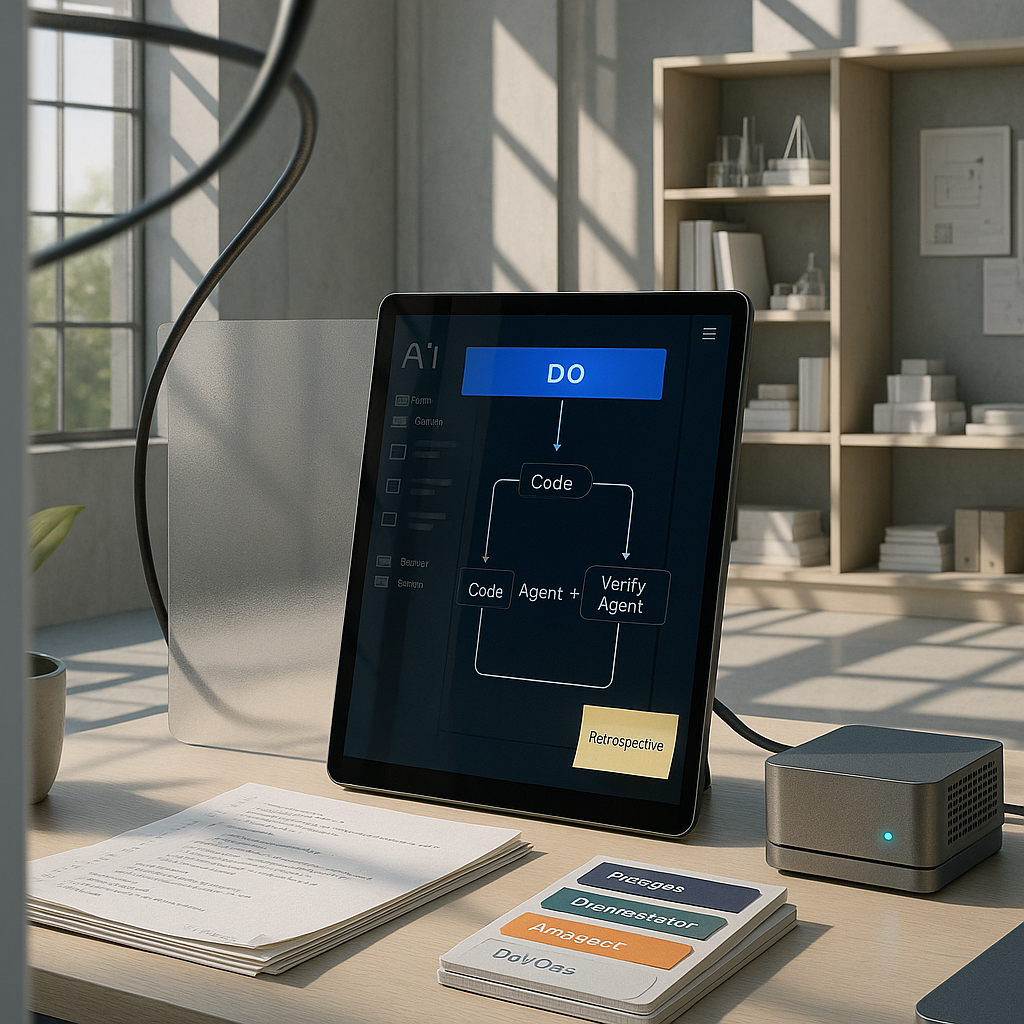
Struggling with slow, risky engineering work? In the past 14 days (posts dated Jan 2–3, 2026) practitioners published concrete frameworks showing AI moving from toy to governed teammate—what you get here are practical primitives you can act on now. They surfaced PDCVR (Plan–Do–Check–Verify–Retrospect) as a daily, test‐driven loop for AI code, folder‐level manifests plus a prompt‐rewriting meta‐agent to keep agents aligned with architecture, and measurable wins (typical 1–2 day tasks fell from ~8 hours to ~2–3 hours). They compared executable workspaces (DevScribe) that bundle DB connectors, diagrams, and offline execution, outlined AI‐assisted, idempotent backfill patterns crucial for fintech/trading/health, and named “alignment tax” as a coordination problem agents can monitor. Bottom line: this isn’t just model choice anymore—it’s an operating‐model design problem; expect teams to adopt PDCVR, folder policies, and coordination agents next.

AI-Native Engineering Model Speeds Development with PDCVR and Meta-Agents

What happened

In the last two weeks practitioners published concrete patterns showing an AI‐native operating model for engineering: a governed coding loop called PDCVR (Plan–Do–Check–Verify–Retrospect), folder‐level policies plus meta‐agents that expand short human prompts into full tasks, and execution‐centric workspaces (notably DevScribe) that let agents run queries, tests and diagrams locally. The pieces were demonstrated across Reddit posts, a GitHub repo with templates and subagents, and tool documentation; authors report faster task cycles and clearer guardrails but stress human review remains essential.

Why this matters

Operational shift — models as governed participants. These developments move AI from a “bolt‐on coder” to a structured, auditable member of engineering workflows. Practical impacts include:

  • Faster iteration: one engineer reports typical 1–2 day tasks dropping from ~8 hours to ~2–3 hours using meta‐agents + PDCVR.
  • Better architectural control: folder‐level manifests constrain agent changes, reducing sideways dependencies and improving reuse.
  • Stronger verification: VERIFY uses specialized agent subcomponents and executable workspaces (DevScribe) to run builds, tests, queries and static checks locally, important for regulated sectors (fintech, trading, digital‐health).
  • Risk focus: data backfills and migrations are reframed as guarded PDCVR workflows (idempotence, chunking, observability), and teams are beginning to measure the “alignment tax” — coordination overhead from scope drift and missing owners — which agents could help surface.

Risks/limits noted by practitioners: outputs aren’t flawless, verification still requires human judgement, and coordination/ownership remain major friction points.

Sources

Cutting Task Cycle Time: Boosting Efficiency with Agentic Development

  • Engineer time per 1–2 day task — 2–3 hours, down from ~8 hours pre‐agents, cutting cycle time for typical tasks through agentic development.
  • Initial prompt creation time — ≈20 minutes, reducing upfront context‐setting by using a prompt‐rewriting meta‐agent.
  • Feedback iteration time per loop — 10–15 minutes, with 2–3 loops per task enabling rapid correction cycles with less manual setup.
  • Manual testing time — ≈1 hour, preserving human verification while keeping total effort within a 2–3 hour window.

Mitigating Data Integrity, Security, and AI Compliance Risks in Regulated Stacks

  • Bold risk label and why it matters: Data‐migration/backfill integrity in regulated stacks — backfills touching balances, positions, P&L histories, and patient data can create inconsistencies or compliance breaches if halted mid‐run or run without idempotence, centralized state, and standardized observability; this is “not optional” in fintech/trading and digital‐health‐ai. Opportunity: Stand up a governed data‐migration platform over PDCVR + agents (invariants, rollback rules, integrity checks) to produce auditable runs, benefiting Risk, Data Engineering, and Compliance.
  • Bold risk label and why it matters: Agentic code governance and security drift (est.) — multi‐agent systems and prompt‐rewriting meta‐agents can violate domain invariants, create cross‐layer calls, or embed incorrect dependencies if folder‐level manifests are missing or stale, raising SDLC and audit risks in critical stacks. Opportunity: Treat the repo as a policy substrate (folder manifests) and institutionalize PDCVR VERIFY sub‐agents with retrospectives to harden controls and traceability, benefiting CTO/CISO and platform teams.
  • Bold risk label and why it matters: Known unknown: Real‐world quality and regulatory acceptance of the AI‐native operating model — efficiency claims (~8 hours to ~2–3 hours per 1–2 day task) come with “output is not magically perfect,” leaving open residual defect rates, failure modes, and whether auditors/regulators will accept AI‐authored changes and DevScribe‐managed artifacts. Opportunity: Run controlled pilots with metrics (defects, rollback rates) and evidentiary logs from PLAN/VERIFY/RETROSPECT to win compliance approval and de‐risk scale‐up for fintech, trading, and digital‐health teams.

Key AI Engineering Milestones and Impacts Planned for Early 2026

PeriodMilestoneImpact
Jan 2026 (TBD)Teams adopt PDCVR using open-sourced prompt templates and single-objective discipline.Shift to scoped patches, improved TDD correctness/maintainability in AI coding.
Jan 2026 (TBD)Integrate .claude/agents VERIFY suite into CI to enforce builds/tests for AI code.Independent checks reduce lint/compile failures; stronger governance for AI-written code.
Jan 2026 (TBD)Roll out folder-level manifests and meta‐agent prompt expander across repos.Cut engineer time to 2–3 hours per task; fewer cross-layer calls.
Q1 2026 (TBD)Launch standardized data‐migration/backfill platform with idempotency, chunking, throttling, backpressure.Safer historical backfills; centralized state, rollbacks, and integrity checks in production.
Q1 2026 (TBD)Pilot coordination‐monitoring agents to quantify the alignment tax across programs.Flag scope deltas, dependency shifts, missing reviews; visualize coordination bottlenecks.

From Bigger Models to Governed AI: Why Controlled Friction Accelerates Real Work

Proponents argue the quiet revolution isn’t bigger models but a governed way to use them. PDCVR narrows objectives, shrinks diffs, and turns agents into auditable coworkers; folder-level manifests convert repos into policy, while a meta‐agent reduces prompt overhead. The reported result: 1–2 day tasks dropping from about eight engineer hours to roughly two to three, with humans focusing on design and risk. Skeptics counter that this can read as process theater—more loops, more agents, more manifests—and still, as one engineer concedes, output is “not magically perfect.” Data migrations remain bespoke in many shops, and the alignment tax—shifting requirements, surprise dependencies, missing reviewers—still drags teams while tooling offers almost no visibility. Provocation: if your AI can’t survive CHECK and VERIFY, you don’t have a strategy—you have a chatbot with commit rights. The article’s own caution is timing: these frameworks landed in the last two weeks—credible, but early—and coordination, not coding, may still be the bottleneck.

The counterintuitive takeaway is that adding friction—single‐goal plans, policy‐bound navigation, offline execution workspaces—actually releases speed and reduces risk; here, governance is the accelerator. Treat AI as a governed participant across code, data backfills, and coordination, and the biggest gains may arrive outside the editor: agents that quantify scope deltas, enforce folder invariants, and verify migrations could cut the alignment tax more than another leaderboard jump ever will. What shifts next is the locus of advantage—from model choice to operating‐model design—especially for fintech, trading, digital‐health teams, and the CTO/CISO seats that must prove control. Watch for DevScribe‐like control planes, standard folder manifests, PDCVR playbooks for backfills, and review agents that flag misalignment before it ships. The next breakthrough isn’t a model; it’s the model of work.