AI-Native SDLC: PDCVR, Agentic Workflows, and Executable Workspaces

AI-Native SDLC: PDCVR, Agentic Workflows, and Executable Workspaces

Published Jan 3, 2026

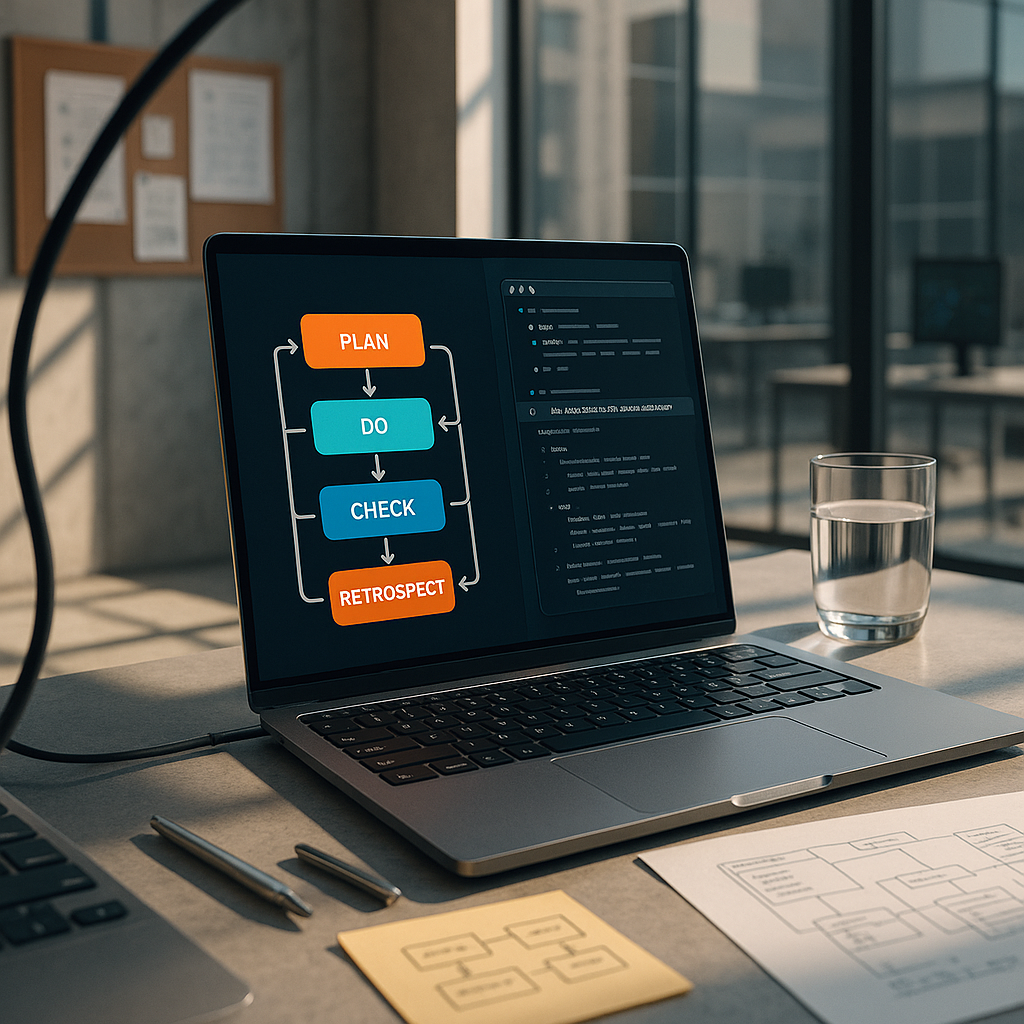
Tired of AI “autocomplete” causing more rework? Reddit threads from 2026‐01‐02–03 show senior engineers wrapping LLMs into repeatable processes—here’s what matters for your org. They describe a Plan–Do–Check–Verify–Retrospect (PDCVR) loop (Claude Code + GLM‐4.7) that enforces TDD stages, separate build/verification agents, and prompt‐template retrospectives for auditability—recommended for fintech, biotech, and safety‐sensitive teams. Others report folder‐level manifests plus a prompt‐rewriting meta‐agent cutting 1–2‐day tasks from ~8 hours to ~2–3 hours (3–4× speedup). Tool trends: DevScribe’s “executable docs,” rising need for robust data‐migration/backfill frameworks, and coordination‐aware agent tooling to reduce weeks‐long alignment tax. Engineers now demand reproducible evals, exact prompts, and task‐level metrics; publish prompt libraries and benchmarks, and build verification and migration frameworks as immediate next steps.

Senior Engineers Adopt Disciplined AI Development with PDCVR Loop Innovation

What happened

Senior engineers are moving from ad‐hoc prompting to disciplined, audit‐friendly AI development processes. Notable posts on r/ExperiencedDevs (1–3 Jan 2026) describe a Plan–Do–Check–Verify–Retrospect (PDCVR) loop built on Claude Code and GLM‐4.7, folder‐level manifests and prompt‐rewriting meta‐agents that cut typical 1–2 day tasks from ~8 hours to ~2–3 hours, plus a comparison of “executable” workspaces (DevScribe) vs. Obsidian. Threads also call out data‐migration/backfill as a platform problem, the cost of coordination (“alignment tax”), an AI todo aggregator ingesting Slack/Jira/Sentry, and practitioner demands for reproducible prompts and metrics.

Why this matters

Tooling and process shift — from experiments to engineering discipline.

  • Scale & productivity: reported 3–4× speedups on common tasks suggest major throughput gains if these workflows generalize across teams.
  • Risk & compliance: PDCVR-style loops, folder manifests, and verification agents add auditability and reproducibility, important for fintech, biotech, and safety‐sensitive systems.
  • Platform opportunity: recurring pain around incremental backfills and coordination indicates demand for shared migration frameworks, dependency‐aware agents, and task‐router products.
  • Design constraint: practitioners want concrete evals — exact prompts, models, and before/after metrics — so vendors and teams will need to publish reproducible case studies, not anecdotes.
  • Risks include overreliance on agentic chains without human oversight, possible subtle architecture violations if manifests are incomplete, and new operational complexity from added verification agents.

Sources

  • PDCVR loop post (r/ExperiencedDevs, 2026‐01‐03): https://www.reddit.com/r/ExperiencedDevs/comments/1q2m46x/plandocheckverifyretrospectaframeworkforai/
  • PDCA for AI code generation (Pawlak, InfoQ, 2023): https://www.infoq.com/articles/PDCA-AI-code-generation/
  • TDD with LLMs paper (Siddiq et al., 2023, arXiv): https://arxiv.org/pdf/2312.04687
  • PDCVR subagents & prompts (GitHub, accessed 2026‐01‐03): https://github.com/nilukush/plan-do-check-verify-retrospect/tree/master/claude-code-subagents-for-coding
  • DevScribe product site (accessed 2026‐01‐03): https://devscribe.app/

Accelerating Engineering Workflows: Faster Tasks, Prompts, Feedback, and Testing

  • Engineering time per typical 1–2 day task — 2–3 hours, 3–4× faster vs ~8 hours pre-agents with structured agentic workflows while maintaining or slightly improving code quality.
  • Initial prompt crafting time — ~20 minutes, enabled by a prompt‐rewriting meta‐agent that reduces upfront human effort.
  • Feedback loop duration — 10–15 minutes per loop, enabling 2–3 rapid iteration cycles that drive faster convergence.
  • Testing and verification time — ~1 hour, showing QA remains manageable while overall cycle time drops significantly.

Mitigating AI Code Risks and Ensuring Compliance in Regulated Workflows

  • Compliance/auditability risk for AI-authored code in regulated SDLCs: In fintech, biotech, and other safety‐sensitive domains that “need auditability and reproducibility,” uncontrolled AI coding can stall adoption or create liability if changes aren’t test‐driven, verified, and traceable. Opportunity: Institutionalize PDCVR loops, TDD‐with‐LLMs, and separate verification agents to produce auditable artifacts and reproducible diffs, enabling compliance wins for platform vendors and regulated engineering orgs.
  • (est.) Data security & governance gaps in executable, offline‐first workspaces and agentic task routers: DevScribe’s inline DB read/write (MySQL/PostgreSQL/SQLite/MongoDB/Elasticsearch) and Postman‐like API calls stored locally, plus AI systems that ingest Slack/Jira/Sentry, can expose sensitive data and bypass centralized controls and logging. Opportunity: Build enterprise controls—sandboxing, least‐privilege connectors, secrets management, fine‐grained RBAC, DLP, and immutable audit logs—creating a security moat for vendors and reducing breach/compliance risk for security/infra teams.
  • Known unknown: Reproducibility of the claimed 3–4× engineering speedup with agentic workflows: Reported gains (8h → 2–3h per task with 2–3 feedback loops) are anecdotal, and practitioners explicitly demand task‐level prompts, setups, and metrics to validate quality and throughput. Opportunity: Teams that publish standardized evals, prompt libraries, and before/after KPIs (defect rates, PR review time, lead time) can win credibility and budget from leadership and regulated stakeholders.

Key 2026 Milestones Driving Productivity and Engineering Workflow Innovation

PeriodMilestoneImpact
Jan 2026 (TBD)r/ExperiencedDevs practitioners publish reproducible evals: prompts, models, metrics, outcomes.Validate PDCVR/agentic workflows; confirm or refute 3–4× productivity claims.
Jan 2026 (TBD)AI todo aggregator founder opens alpha/waitlist integrating Slack, Jira, Sentry.Consolidates fragmented work streams; improves follow‐up reliability for engineering teams.
Jan 2026 (TBD)Org trials comparing DevScribe vs Obsidian for executable engineering workflows.Decide tool standardization for APIs, databases, diagrams; ensure offline‐first ownership.
Q1 2026 (TBD)Production pilots of folder manifests and prompt‐rewriting meta‐agents in large codebases.Measure architecture compliance, defect rates; target sustained 3–4× time reduction.
Q1 2026 (TBD)Launch proposals for data migration/backfill frameworks with idempotent workers and checkpoints.Safer incremental backfills; rollback support; precise migration state tracking.

Process, Not Model Size, Will Shape the Real Future of AI Development

Depending on where you sit, this week’s posts read as evidence that AI is growing up—or as a new layer of ceremony waiting to calcify. Advocates point to PDCVR’s plan‐do‐check‐verify‐retrospect cadence, TDD‐with‐LLMs results on correctness and maintainability, and agentic workflows where folder‐level manifests and a prompt‐rewriting meta‐agent deliver 3–4× speedups without sacrificing quality. Skeptics note this is still an early blueprint, that coordination‐aware agents must surface “concrete, actionable signals” to avoid more noise, and that data migrations remain bespoke despite calls for frameworks. The most pointed critique cuts at the hype itself: structure and context, not bigger models, look decisive. Or put more sharply: The model isn’t the moat; process is. And the community is calling the bluff—one thread demands “precise task descriptions, exact prompts and settings” (Reddit, 2026‐01‐02) before believing any claim, a reminder that reproducibility, not anecdotes, will settle the argument.

Here’s the twist the ARTICLE makes hard to ignore: the supposedly slower path—loops, manifests, state tracking, executable docs—turns out to be the fast lane. Discipline begets speed; local, auditable substrates like DevScribe‐style “docs as IDE,” PDCVR‐style verification agents, and explicit backfill lifecycles are what let the same models punch above their weight. If that holds, the next shift isn’t another model drop but AI‐native SDLC: agent‐readable repos, migration frameworks with checkpoints, coordination sensors watching dependency graphs and approvals, and teams publishing prompt libraries and task‐level metrics instead of slogans. Watch safety‐sensitive shops in fintech and biotech, platform groups wrestling with the “alignment tax,” and any org ready to turn scattered signals from Slack/Jira/Sentry into an accountable queue. Ship the scaffolding first; the rest starts to click.